

Saving the pygmy rabbit
In conservation, saving the smallest animals can sometimes require the biggest effort. The pygmy rabbit is the smallest native rabbit in North America, and from 2002 to 2012, the Oregon Zoo helped prevent the extinction of this native species, becoming the first zoo in the world to successfully breed pygmy rabbits!
Weighing less than one pound when fully grown, it’s not just the smallest native rabbit. The pygmy is also North America’s only rabbit that digs its own burrows, and the only one almost entirely dependent on sagebrush for its survival. Over the last 160 years, sagebrush-covered lands have been converted to agricultural use or planted in exotic bunch grass to improve livestock forage. This has led to sharp decline in pygmy rabbit populations.
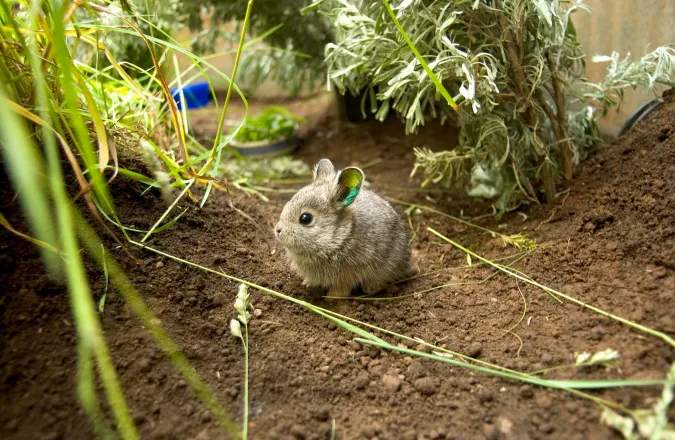
The zoo’s pygmy breeding program played a key role in restoring the population. These kitten-sized rabbits are now slowly repopulating their historic range thanks to the zoo and its conservation partners. It’s a careful process that has spanned decades.
By the early 2000’s, pygmy rabbits were nearing extinct with only 16 remaining in the wild. In 2002, the Washington Department of Fish and Wildlife (WDFW) asked the zoo to develop a breeding program with the goal of reintroducing rabbits to their wild habitat. The breeding program commenced when the remaining 16 Washington pygmy rabbits were placed in programs at the Oregon Zoo, Washington State University and Northwest Trek Wildlife Park in Washington, in collaboration with the WDFW and U.S. Fish & Wildlife Service.
In 2004, zoo-raised offspring were crossbred with wild Idaho pygmy rabbits to strengthen the Columbia basin gene pool and increase the chances of a successful recovery. In spring 2007, 20 captive-bred rabbits were released into Sagebrush Flat Wildlife Area near Ephrata in central Washington.
By 2011, more than 50 rabbits were released. These rabbits were outfitted with tracking technology so they could be monitored. Protective boundaries were placed around their living space within a larger 10-acre wildlife area to safeguard the population from predators.
Thanks to these additional measures implemented by zoo and partners, for the first time in more than a decade, the Columbia Basin pygmy rabbit bred and produced young in the wild. A litter of kits was confirmed in the Sagebrush Flat Wildlife Area in eastern Washington.
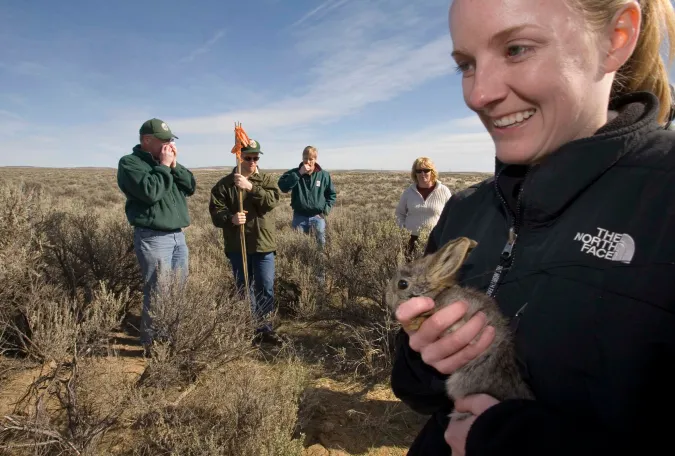
The zoo's 12-year recovery effort concluded in July 2012, when it released its last 14 breeding rabbits and their offspring at the Sagebrush Flat Wildlife Area. Zoo staff and volunteers continued to support field activities during the transition from captive breeding to habitat and landscape-focused conservation efforts.
In 2013, the Oregon Zoo and Northwest Trek were honored with the AZA's North American Conservation Award for their collaborative Columbia Basin pygmy rabbit project. By the end of the partnership, the Oregon Zoo celebrated the successful raising and release of 91 pygmy rabbits to the wild.
Life of a pygmy rabbit
Columbia Basin pygmy rabbits are the smallest rabbit species in North America. They can grow no more than a foot long and weigh less than a pound. Their fur ranges from dark grey to brown with white around their ears.
Pygmy rabbits breed in the spring. Before giving birth, females dig hidden burrows where they give birth and later nest with the young. They can have up to three litters a year, with each containing an average of six young. Many of these young are preyed up within the first five weeks of life. If they do survive into adulthood, pygmy rabbits are ready to breed after one year.
Pygmy rabbits primarily eat sagebrush, especially the winter months. They also eat a variety of grasses that become available in the spring and summer months. Pygmy rabbits have many predators including birds of prey, weasels, badgers, bobcats, foxes and coyotes.
Today, wildfire poses the single greatest threat to pygmy rabbits. Major fires in 2017 and 2020 wiped out large portions of the population. Even so, the species has held on because of intensive, long-term management by the Washington Department of Fish and Wildlife. As of 2025, about 130 pygmy rabbits remain in Washington’s sagebrush country. Their future is still fragile, but their survival so far stands as one of the state’s most notable wildlife recovery successes.
Pygmy rabbits at the zoo
The pygmy rabbit breeding program took place at an offsite location.